If you’re planning to build a website for your business, you’ve probably heard two common terms: static website and dynamic website. At first, they may sound technical, but understanding the difference between static and dynamic website is actually quite simple.
Choosing the wrong type of website can limit your business growth, while choosing the right one can help you attract more customers, improve user experience, and rank higher on Google.
Whether you’re a small business owner, startup founder, freelancer, school, hospital, or eCommerce business, knowing how these websites work will help you make a smarter decision.
In this complete guide, you’ll learn what a static website is, what a dynamic website is, their key differences, advantages, disadvantages, real-life examples, and which one is best for your business in 2026.
What Is a Static Website?
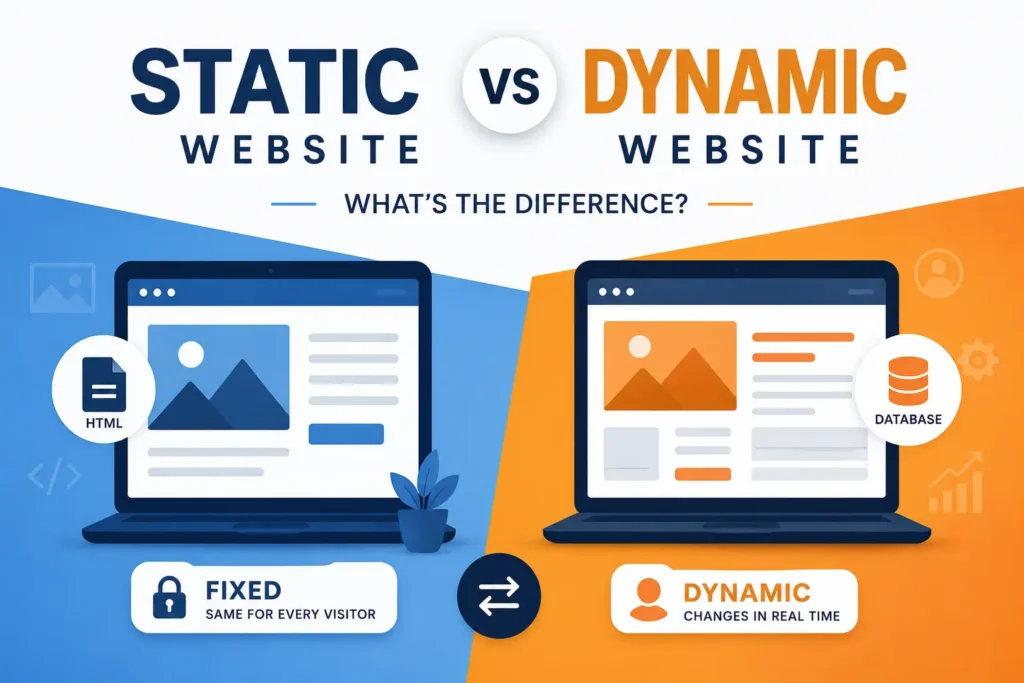
A static website is a website where every page contains fixed content. Every visitor sees the same information because the pages are already created and stored on the server.
These websites are usually built using:
- HTML
- CSS
- JavaScript
If you want to change any text, image, or information, the website files must be edited manually.
Think of a static website like a printed brochure. It looks the same every time someone reads it unless you print a new version.
Examples of a Static Website
- Personal Portfolio
- Resume Website
- Event Website
- Company Profile Website
- Product Landing Page
- Small Business Website
These websites are simple, lightweight, and incredibly fast.
What Is a Dynamic Website?
A dynamic website is much more powerful and flexible.
Instead of showing the same content to every visitor, it generates web pages in real time using a database and server-side programming.
A dynamic website allows business owners to update content through an admin dashboard without touching the code.
For example, if you run a WordPress website, you can easily:
- Publish blog posts
- Update services
- Add products
- Change prices
- Upload images
- Manage enquiries
—all without hiring a developer every time.
That’s why most modern business websites are dynamic.
Examples of Dynamic Websites
- Amazon
- Flipkart
- YouTube
- School Websites
- Hospital Websites
- Real Estate Websites
- Restaurant Websites
- Business Websites
- eCommerce Stores
Almost every large company today uses a dynamic website because it offers unlimited possibilities.
Difference Between Static and Dynamic Website
Understanding the difference between static and dynamic website becomes much easier when you compare them side by side.
| Feature | Static Website | Dynamic Website |
|---|---|---|
| Content | Fixed | Changes Automatically |
| Speed | Very Fast | Fast |
| Database | Not Required | Required |
| Content Updates | Manual | Easy from Dashboard |
| Admin Panel | No | Yes |
| User Login | No | Yes |
| Blog Support | Limited | Excellent |
| eCommerce | Not Suitable | Perfect |
| Scalability | Low | High |
| SEO Opportunities | Good | Excellent |
| Maintenance | Low | Medium |
Both types of websites have their own strengths. The best option depends entirely on your business goals.
How Does a Static Website Work?
A static web page is stored exactly as it is created.
When someone visits your website:
- The browser sends a request.
- The server finds the HTML file.
- The file is delivered directly to the visitor.
There is no database processing or server-side programming involved.
This simple process makes static websites:
- Extremely fast
- Highly secure
- Easy to host
- Budget-friendly
However, every change requires manually editing the website files.
How Does a Dynamic Website Work?
A dynamic website follows a smarter process.
Instead of serving a fixed HTML file, it generates the webpage when a visitor requests it.
Here’s what happens:
- A visitor opens the website.
- The server receives the request.
- Information is fetched from the database.
- The webpage is created instantly.
- The visitor sees the latest content.
For example, if you update a product price in WordPress, every visitor immediately sees the new price without changing any code.
This flexibility makes dynamic websites ideal for growing businesses.
Advantages of a Static Website
Even in 2026, a static website remains a great choice for many businesses.
1. Lightning-Fast Speed
Static websites load extremely quickly because there is no database to process.
Faster loading speeds create a better user experience and can support SEO performance.
2. Better Security
Since there is no database or admin login for visitors to attack, static websites are naturally more secure.
3. Lower Development Cost
A static website usually costs less than a dynamic website because it requires fewer features and less development time.
4. Easy Hosting
Static websites can be hosted on almost any web server with minimal resources.
5. Perfect for Small Businesses
If your business only needs a few pages like Home, About, Services, and Contact, a static website may be all you need.
Advantages of a Dynamic Website
Today’s businesses need websites that can grow with them.
That’s where a dynamic website shines.
Easy Content Management
You can update your website anytime without editing code.
Powerful SEO
Publishing blogs regularly helps your website target more keywords and attract organic traffic.
Unlimited Growth
You can easily add:
- Blogs
- Services
- Products
- Categories
- Customer accounts
- Payment gateways
- Booking systems
as your business expands.
Better Customer Experience
Dynamic websites provide interactive features that keep visitors engaged and encourage them to take action.
Disadvantages of a Static Website
While a static website is fast and affordable, it also comes with a few limitations.
1. Difficult to Update
Every content change requires editing the website files manually. If you frequently update services, pricing, or contact details, this can become time-consuming.
2. Limited Functionality
A static website cannot easily support features like:
- User login
- Online booking
- Shopping cart
- Payment gateway
- Customer dashboard
- Blog management
3. Not Ideal for Growing Businesses
As your business expands, adding new pages and features becomes more challenging compared to a dynamic website.
Disadvantages of a Dynamic Website
A dynamic website offers flexibility but also has a few drawbacks.
Higher Development Cost
Because of advanced features and database integration, a dynamic website generally costs more than a static website.
Regular Maintenance
Software updates, backups, security patches, and plugin updates are necessary to keep the website secure and running smoothly.
Slightly More Complex
Managing a dynamic website requires basic knowledge of a content management system (CMS) like WordPress. However, modern CMS platforms make this easy, even for beginners.
Static Website vs Dynamic Website: Real-Life Examples
Let’s understand with a few practical examples.
Static Website Examples
- Personal Portfolio
- Resume Website
- Event Landing Page
- Digital Visiting Card
- Simple Company Profile
- One-Page Business Website
These websites mainly provide information and don’t require regular updates.
Dynamic Website Examples
- Amazon
- Flipkart
- YouTube
- News Websites
- School Websites
- Hospital Websites
- Restaurant Websites
- Real Estate Websites
- Business Websites with Blogs
- Online Course Platforms
These websites constantly update content and allow users to interact with the platform.
Which Website Is Better for SEO?
One of the biggest questions business owners ask is:
“Which website ranks better on Google?“
The answer is simple:
Both can rank well if they follow SEO best practices.
However, a dynamic website offers a significant advantage because you can:
- Publish blog articles regularly
- Update old content
- Add FAQs
- Improve internal linking
- Optimize images and metadata
- Target new keywords over time
Google values fresh, helpful, and regularly updated content. That’s why most businesses aiming for long-term organic growth choose a dynamic website.
Static Website vs Dynamic Website: Cost Comparison
The cost of a website depends on its complexity, features, design, and future scalability.
| Website Type | Approximate Cost | Best For |
|---|---|---|
| Static Website | Lower | Portfolio, Company Profile, Landing Pages |
| Dynamic Website | Higher | Business Websites, Schools, Hospitals, eCommerce, Blogs |
While a static website is more affordable initially, a dynamic website provides better long-term value because it supports business growth and advanced functionality.
Which Website Should You Choose?
There is no one-size-fits-all answer. The right choice depends on your business goals.
Choose a Static Website if you:
- Need only a few pages
- Rarely update content
- Have a limited budget
- Need a simple online presence
Choose a Dynamic Website if you:
- Want to publish blogs
- Plan to improve SEO
- Need an admin dashboard
- Want online enquiries
- Sell products or services
- Expect your business to grow
For most businesses in 2026, a dynamic website is the smarter investment because it is flexible, scalable, and supports digital marketing efforts.
Common Myths About Static and Dynamic Websites
Myth 1: Static Websites Cannot Rank on Google
False.
A well-optimized static website with quality content and good SEO can rank successfully.
Myth 2: Dynamic Websites Are Slow
Not true.
With proper hosting, caching, and optimization, a dynamic website can load just as fast and provide an excellent user experience.
Myth 3: Static Websites Are Outdated
Incorrect.
Many businesses still use static websites for portfolios, landing pages, and simple company profiles because they are fast, secure, and cost-effective.
Myth 4: Every Business Needs a Static Website
Today, most growing businesses benefit more from a dynamic website, especially if they want to generate leads, publish content, and expand online.
Frequently Asked Questions (FAQs)
1. What is the main difference between a static and dynamic website?
A static website displays fixed content to every visitor, while a dynamic website generates content in real time and allows easy updates through a dashboard.
2. Which website is faster?
A static website is generally faster because it serves pre-built pages without querying a database. However, a well-optimized dynamic website can also deliver excellent performance.
3. Which website is better for SEO?
Both can perform well, but a dynamic website gives you more opportunities to publish fresh content, improve internal linking, and grow your organic traffic.
4. Can I convert a static website into a dynamic website later?
Yes. Many businesses start with a static website and later migrate to a dynamic platform like WordPress as their requirements increase.
5. Which website is best for small businesses?
If your website only needs basic information, a static website may be sufficient. However, if you plan to grow, market your business online, or publish blogs, a dynamic website is usually the better choice.
Final Thoughts
Understanding the difference between static and dynamic website is the first step toward building a successful online presence.
A static website is an excellent choice for simple projects that require speed, security, and affordability. A dynamic website is designed for businesses that want flexibility, better customer engagement, and long-term growth.
Instead of choosing based only on cost, think about where you want your business to be in the next three to five years. The right website should not only meet your current needs but also support your future ambitions.
Build the Right Website with WebsiteDad
Whether you need a fast static website or a powerful dynamic website, WebsiteDad helps businesses build professional, SEO-friendly, and high-performance websites tailored to their goals.
From business websites and eCommerce stores to custom web solutions, our team creates websites that are built to grow with your business.
Ready to take your business online?
Visit www.websitedad.com and let WebsiteDad help you build a website that attracts customers, builds trust, and drives long-term success. 🚀