Imagine the last time you needed to order takeout, search for a local plumber, or buy a new laptop online. Where was your very first stop?
Most likely, you reached for your phone or laptop, launched a web browser, and navigated to a web destination.
In our hyper-connected world, having a presence online is just as crucial as having a physical storefront. Whether you are checking breaking news, streaming videos, or managing an enterprise, websites form the backbone of the internet. Yet, if you pause to evaluate the fundamental question—what is a website?—the surrounding jargon can quickly feel overwhelming.
In this comprehensive guide, we will unpack the core website meaning, examine various types of websites, demystify how a website works, and outline why launching a website for business success is vital in 2026.
Website Meaning: What Is a Website?
To simplify the website definition as cleanly as possible:
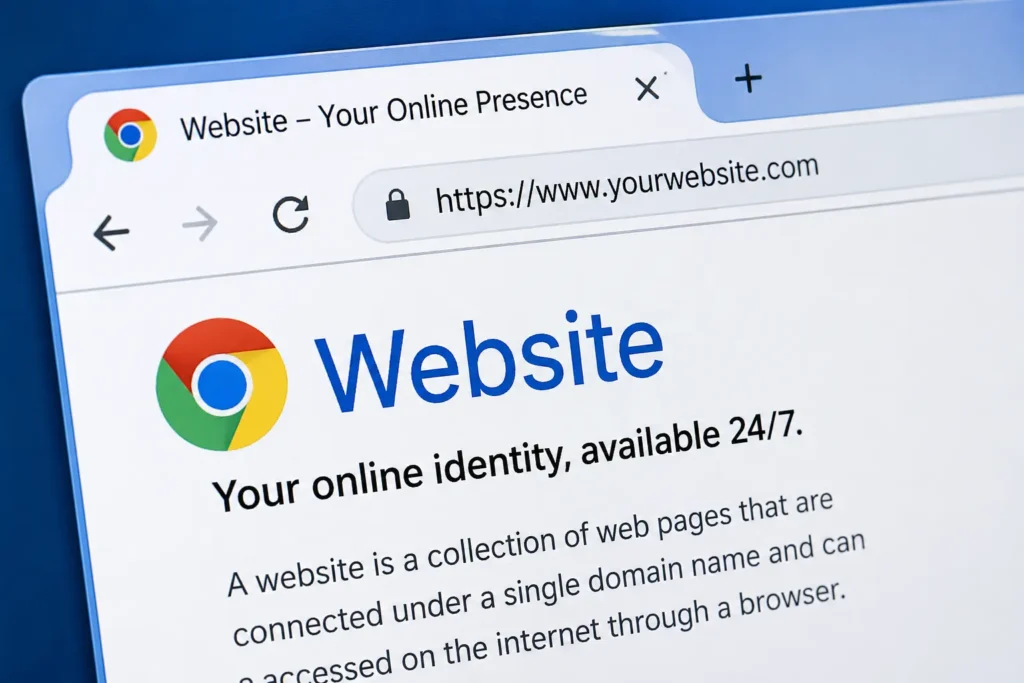
A website is a grouped collection of connected web pages hosted under a single domain name.
Consider a website as equivalent to a physical book. The domain address (such as google.com or websitedad.com) serves as the title printed on the cover, while the individual pages within function as chapters packed with copy, media, forms, and hyperlinks.
Websites are stored on specialized, always-connected computers called web servers. Anyone can access them instantly using popular web browsers like Google Chrome, Apple Safari, or Mozilla Firefox.
       [ YOUR BROWSER ]
              │  ▲
 1. Requests  │  │  2. Delivers
   Webpage    ▼  │    Files
       [ WEB SERVER ]
Website vs Web Page: What’s the Difference?
While people often interchange these two terms, understanding the distinction is essential when strategizing your digital strategy.
- Web Page: A single, individual document residing on the web with a unique URL address (e.g.,
[example.com/about-us](https://example.com/about-us)). Think of it as one specific page in a printed book. - Website: A complete collection of connected web pages operating under a master domain address. Think of it as the entire book.
| Feature | Web Page | Website |
| Scope | A single standalone document | A collection of interlinked documents |
| URL Example | [websitedad.com/services](https://websitedad.com/services) | websitedad.com |
| Analogy | One page of a book | The whole book |
| Purpose | Delivers specific content or a single call-to-action | Offers a complete brand experience or platform |
How Does a Website Work? (Simplified)
AS you understood above that What Is a Website. No we come how does this ? You don’t need technical engineering experience to grasp how web infrastructure operates. Here is a streamlined 4-step sequence occurring in milliseconds whenever someone inputs a web address:
- The Address Lookup (Domain Name): You enter a web link into your URL bar. The Domain Name System (DNS)—functioning like a global phonebook—translates that human-readable address into a numerical IP code.
- The Server Request: Your web browser sends a secure request across the internet to the server hosting those specific files.
- Data Retrieval: The host server fetches all core code (HTML, CSS, JavaScript) alongside images or databases, packaging them back to your device.
- Visual Rendering: Your browser interprets that raw code and renders it into the clean, interactive layout displayed on your screen.
7 Popular Types of Websites with Real Examples
Web platforms are built for vastly different objectives. Depending on your operational goals, a site can range from a single display card to a complex global enterprise portal.
1. Business Websites
What is a business website? It is a central digital hub engineered to present a brand online, introduce services, build market trust, and convert passive traffic into qualified sales leads.
- Primary Goal: Establish industry trust, communicate value, and generate incoming inquiries.
- Real Examples: Website Dad (web development agency), McKinsey & Company, local dental practices.
2. E-Commerce Websites
E-commerce portals empower customers to explore product catalogs, add items to a virtual cart, and complete financial transactions directly over secure payment gateways.
- Primary Goal: Drive direct online product sales and automate order fulfillment.
- Real Examples: Amazon, Shopify store platforms, Nike.
3. Portfolio Websites
Designed specifically for creative professionals—such as freelancers, designers, copywriters, and architects—to showcase past projects and demonstrate past results.
- Primary Goal: Display expertise and win new client contracts or agency roles.
- Real Examples: Behance, Adobe Portfolio sites, independent creative showcases.
4. Blogs and News Websites
Focus on publishing regular informational content, industry insights, or news coverage structured logically by publication date or specific category.
- Primary Goal: Inform, entertain, capture organic search traffic, and generate advertising or affiliate income.
- Real Examples: TechCrunch, The Verge, Medium.
5. Educational Platforms (LMS)
Interactive portals designed to host structured video modules, certifications, quizzes, and learning materials for self-paced or structured instruction.
- Primary Goal: Deliver scalable online instruction and track student progress.
- Real Examples: Coursera, Udemy, Khan Academy.
6. Social Media & Community Platforms
Dynamic platforms designed around interactive user networking, discussion boards, real-time communication, and content sharing.
- Primary Goal: Encourage user-created posts and enable ongoing online interaction.
- Real Examples: Reddit, LinkedIn, X (Twitter).
7. Landing Pages
Focused, standalone web pages designed explicitly for targeted ad campaigns, urging visitors toward one single strategic goal (e.g., claiming a free consultation or downloading a resource).
- Primary Goal: Maximize advertising conversions and capture targeted leads.
Why Is a Website Important? Key Benefits of Having a Website
For business leaders and entrepreneurs, evaluating the importance of website development comes down to scalable growth and audience reach. Here are five core advantages:
1. 24/7 Always-On Presence
Unlike brick-and-mortar storefronts bounded by fixed operational hours, a digital portal stays open constantly. Prospects can research your services, read reviews, or place orders at any hour of the night.
2. Immediate Brand Credibility
Modern consumers expect legitimate companies to maintain a polished online destination. A fast, well-designed site serves as instant validation—lacking one often makes prospects question a company’s reliability.
3. Continuous Organic Traffic (SEO)
Implementing search engine optimization (SEO) helps position your business directly in front of active buyers on search engines like Google, driving consistent organic leads without continuous ad spend.
4. Direct Digital Ownership
While social media profiles are useful, you remain vulnerable to sudden algorithm updates or platform policy changes. Your website represents owned digital media where you control every aspect of design and messaging.
5. The Anchor of Your Marketing Strategy
Your website acts as the destination hub for all promotional channels—from Google PPC and social campaigns to email marketing. Every campaign should direct users back to convert on your site.
How to Get a Professional Website for Your Business
Constructing an effective digital presence involves far more than simply selecting visual layouts. It demands rapid loading performance, full mobile responsiveness, clean UI design, and robust search engine optimization.
If you are looking for a tailored, high-performance site engineered to scale your enterprise without technical roadblocks, working with a specialized team ensures your goals are met efficiently.
Looking to build a high-performing and best website for your business?
Website Dad is a best website development company and digital marketing agency which is specialized in web development agency dedicated to designing fast, custom, and conversion-focused websites for business owners. Whether you are launching a new venture or updating an existing platform, explore how they can help at www.websitedad.com
Frequently Asked Questions (FAQs)
What is the primary purpose of a website?
While goals vary by industry, a website primarily serves to share tailored information, capture qualified leads, sell goods or services, and establish an authentic online identity.
How much does it cost to build a website?
Investment levels depend on functionality. Basic starter sites or DIY landing pages can cost relatively little annually for hosting and domain management, whereas fully custom business platforms or scalable e-commerce systems range higher depending on custom features and technical requirements.
Do I need coding skills to create a website?
No. Modern platforms like WordPress or Shopify allow non-technical owners to update content easily. However, configuring advanced features, optimized user paths, and custom SEO strategy typically yields much better performance when handled by professional web developers.
Conclusion : I hope you know all about what is a website and understand about basic website.